
From symptoms to causes

With increasingly dynamic markets and growing uncertainty in the environment more and more businesses seek ways to improve their planning and budgeting processes. Most executives recognise the shortcomings of traditional planning and budgeting. But what to replace it with? Should we make incremental changes to fix the worst issues, should we turn to zero-based budgeting, driver-based forecast, activity-based budgeting, or even choose the more radical alternative of overhauling the whole management model with a Beyond Budgeting initiative? How should we decide?
A practical way is to start by identifying the problems we currently have with our planning and budgeting procedures. Change starts with identifying a problem. But often, the problems we experience are not really the actual problems, but rather effects of underlying problems. Our tendency, however, is to treat the symptom instead of the disease and jump right to a solution. But such fixes are unlikely to work, we only patch up the symptoms instead of fixing the problems.
Often a problem is not really a problem, but just a manifestation or symptom of an underlying core problem
One of the most important 20th century management thinkers, Dr. Eliyahu M. Goldratt, author of The Goal and inventor of the Theory of Constraints, developed an excellent toolbox he called "Thinking Processes", designed to identify and fix core problems in organisations. Those tools can be used effectively to find the core contradictions that prevent us from taking the right decisions, to identify core problems in our processes and to map out the route to a better approach. The framework has since been refined and enhanced by H. William Dettmer, a key authority on the method and author of "The Logical Thinking Process - A Systems Approach to Complex Problem Solving".
Using the Thinking Process tool for identifying root causes, the Current Reality Tree, we can effectively move from symptoms through root causes to the underlying core problems.
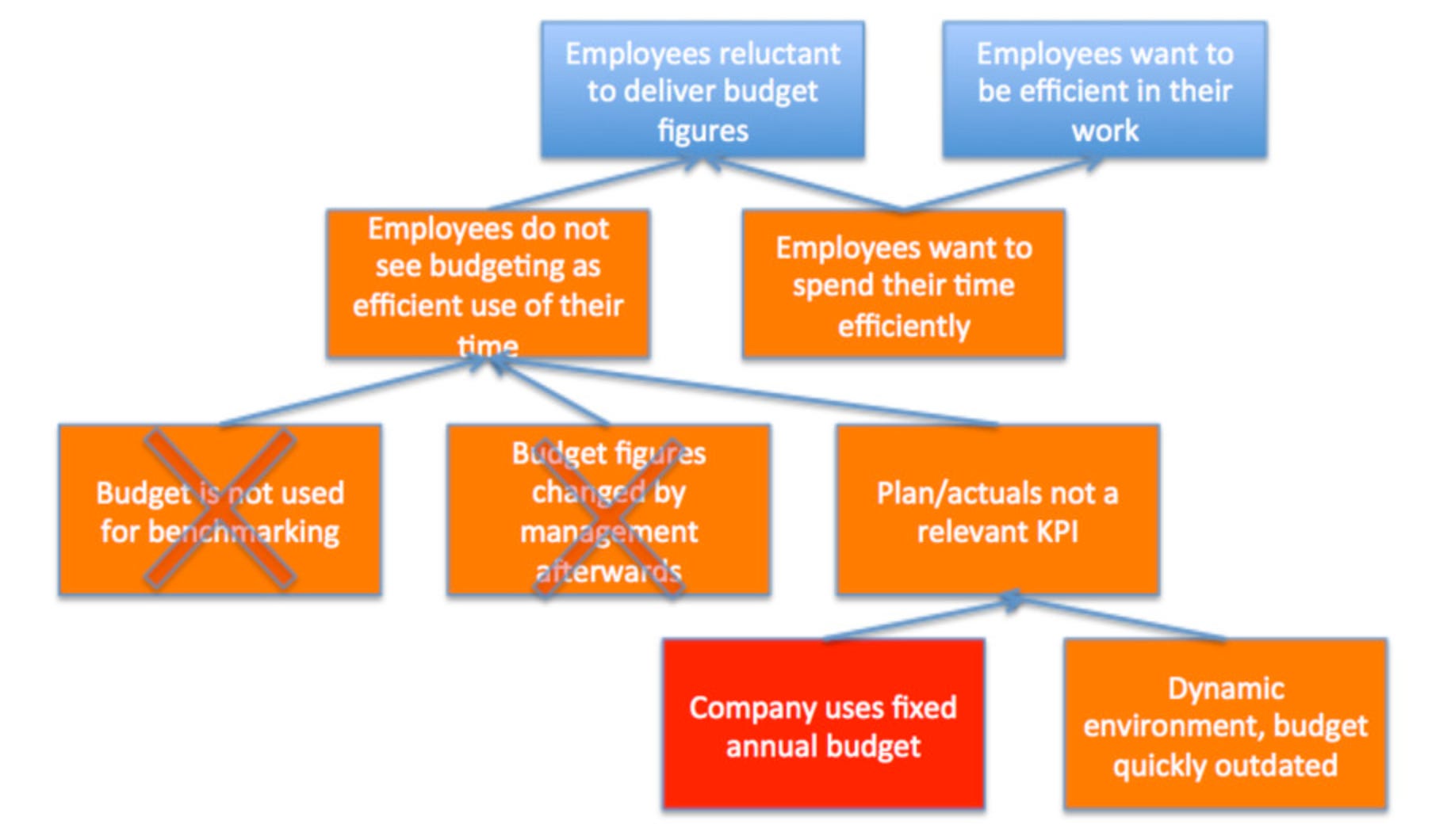
Let us start with the common situation where employees lacking commitment to effectively deliver in the budgeting process. The traditional way would be to immediately jump to solutions, like setting up a seminar, linking the budgeting work with an annual performance review or even firing the most disgruntled employees and hiring new ones. This is unlikely to lead to results, simply because the lack of commitment is not a problem in itself, it is only a symptom. Behind it is a core problem, and it is the core problem that must be identified and fixed. In this case the analysis might look a bit like the picture above: We have already found that employees are in fact committed to their work, they're not just lazy. This means they probably don't think the budgeting process adds value. We can then suggest some explanations. Perhaps the budget figures are not used and the process therefore judged to be pointless. Perhaps the figures are changed afterwards by management. Those are common reasons. Let's say we have analysed and ruled those out, ending up with the explanation that people find performance evaluation based on plan/actual comparison to be irrelevant. The reason is that the budget is an annual, rigid exercise but due to the rate of change in the market it becomes obsolete almost as soon as it has been agreed upon. Now we know precisely what is wrong and can move on to solve the problem.
This is a very simple example of course, but it demonstrates how we can effectively use the Current Reality Tree to find the right direction to improvement by mapping out the symptoms we experience and linking them to core problems.